FAQ
The ASTM F2043 classification system is the industry standard for defining what a bicycle is actually designed to do. Think of these as "intended use" ratings that tell you how much abuse a bike can take before you’re pushing your luck.
Here is a breakdown of the five categories:
ASTM Category 1: Paved Roads
These bikes are designed for riding on smooth, paved surfaces (asphalt or concrete). They are built for efficiency and speed, not impacts.
Intended Surface: Smooth roads only.
Prohibited: Off-road use, jumps, or unpaved trails.
Common Bikes: Performance road bikes, time trial bikes, and urban commuters.
ASTM Category 2: Unpaved/Gravel Roads
Category 2 adds a bit of versatility. These bikes handle well-maintained gravel paths and smooth dirt trails with moderate grades.
Intended Surface: Paved roads plus smooth gravel or dirt paths.
Max Drop: Occasional drops or hops of less than 15 cm (6 inches).
Common Bikes: Gravel bikes, cyclocross bikes, and some trekking hybrids.
ASTM Category 3: Cross-Country (XC)
This is the entry point for "real" mountain biking. These bikes are built for technical trails and rougher terrain where the tires might leave the ground more frequently.
Intended Surface: Rough trails, obstacles, and loose surfaces.
Max Drop: Jumps and drops of less than 61 cm (24 inches).
Common Bikes: XC hardtails and short-travel full-suspension mountain bikes.
ASTM Category 4: All-Mountain / Enduro
Category 4 bikes are beefier and designed for aggressive trail riding. They are built to handle high speeds on very rough terrain and significant impacts.
Intended Surface: Rough technical terrain with larger obstacles.
Max Drop: Jumps and drops of less than 122 cm (48 inches).
Common Bikes: Trail bikes and Enduro bikes.
ASTM Category 5: Gravity / Downhill
The "extreme" category. These bikes are engineered for the highest level of stress, including high-speed descents on "unrideable" terrain and massive airtime.
Intended Surface: Bike parks, downhill racing, and extreme freeride trails.
Max Drop: Unrestricted (within reason), designed for drops over 122 cm (48 inches) and very high speeds.
Common Bikes: Downhill (DH) bikes and heavy-duty Freeride bikes.
e*thirteens e*spec line of components are specifically designed and tested for Class 1 ebikes. Any use on Class 2, Class 3, or beyond category class ebikes is not approved and will void the warranty of the product being used.
- Type: Pedal-assist only.
- Assistance Speed: Motor assistance cuts off once the bike reaches 20 mph.
- Throttle: No throttle is present.
- Type: Features both pedal-assist and a throttle.
- Assistance Speed: The motor provides assistance up to 20 mph, whether by pedaling or using the throttle.
- Throttle: A throttle allows for electric propulsion without pedaling.
- Type: Pedal-assist only.
- Assistance Speed: Motor assistance cuts off at 28 mph.
- Throttle: No throttle is present.
- Speedometer: A speedometer is required.
We don't have weight limits on any of our products, but we do recommend sensible product selection based on a multitude of uses cases/scenarios.
Heavier and more aggressive riders should be aware of more frequent service needs for their use cases. More frequent servicing of dropper posts, hubs and wheel tensioning and truing are the norm for heavier and more aggressive riders. If lightweight componentry is used in conjunction with a heavy or particularly aggressive or high-milage use case, service needs on things like lightweight wheels will be notably increased.
Here is an article where you can read about the intended use for each of our different product categories: XCX, TRS, and LG1? Base, Plus and Race? What does all that mean?
If you still have questions, feel free to reach out to us and we are happy to help recommend the appropriate product based on things like how/where the product is going to get ridden, rider weight, and lightness vs durability preferences.
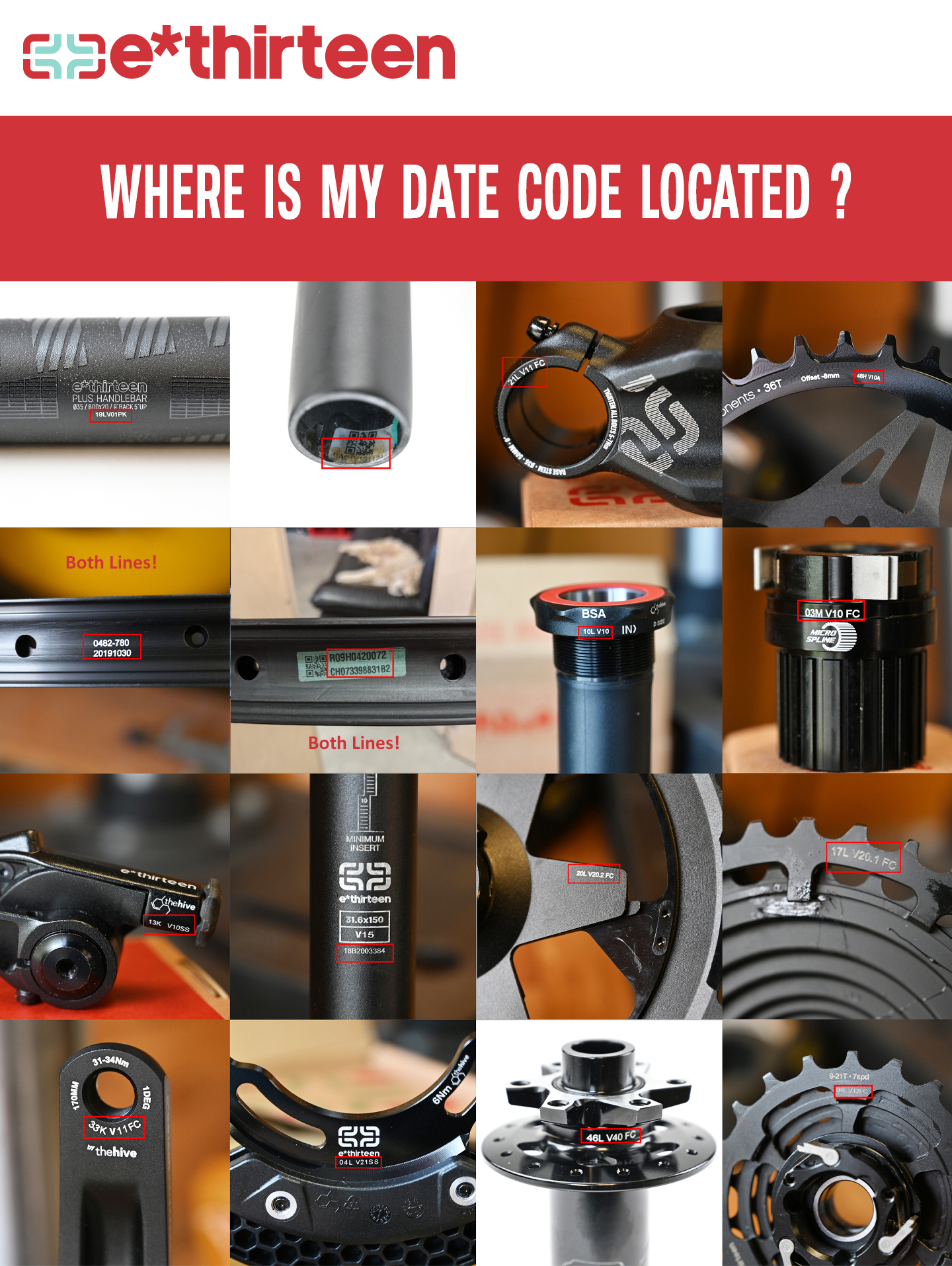
Product date code: an alpha-numeric code found on your product that indicates the year and week in which your product was made.
In addition to a date code, many products will have a version code and/or serial number.
Just send us everything you see, or better yet, take a picture of the appropriate area and send that too!
Location on product:
- Carbon Rims - Label under the rim tape : 2 codes, mixed letters and numbers, 11 and 13 digits long
- Aluminum Rims - Laser etched under the rim tape
- Cassette - Laser etched on the faces of each steel/alloy section at the location where they interface
- Cranks - Laser etch or decal on the inward facing surface of each crankarm near the pedal hole
- Hubs - on flanges
- Wheels - indicate the date code for the damaged part (IE Hub or Rim, for spokes give the hub code)
- Seatpost - below max height line on lower tube
- Tires - Printed inside the casing
- Handlebars - inside edge of the bar
- Stem - at the top cap interface location
- Chainguide - on the backplate
Letter Years:
R: 2025 / Q: 2024 / P: 2023 / O: 2022 / N: 2021 / M: 2020 / L: 2019 / K: 2018 / J: 2017 / I: 2016 / H: 2015 / G: 2014 / F: 2013 / E: 2012 / D: 2011 / C: 2010